
Did you know you can increase your tolerances by over 50 %, without compromising function or fit?
One mistake in design is locating a hole using traditional coordinate tolerances, such as X ± 0.001 m and Y ± 0.001 m. At first glance, this seems straightforward, but it actually creates a square tolerance zone.
This means the allowed variation forms a square with a total area of 4*10-6 m2, since it spans 0.002 m in both X and Y. However, the critical detail lies in the corners of that square. The furthest possible deviation from the true center occurs at a corner, where the offset isn’t 0.001 m, but 0.0014 m.
Now, if your part still functions perfectly when the hole is offset by 0.0014 m diagonally, then that distance represents the true functional limit, not the square itself.
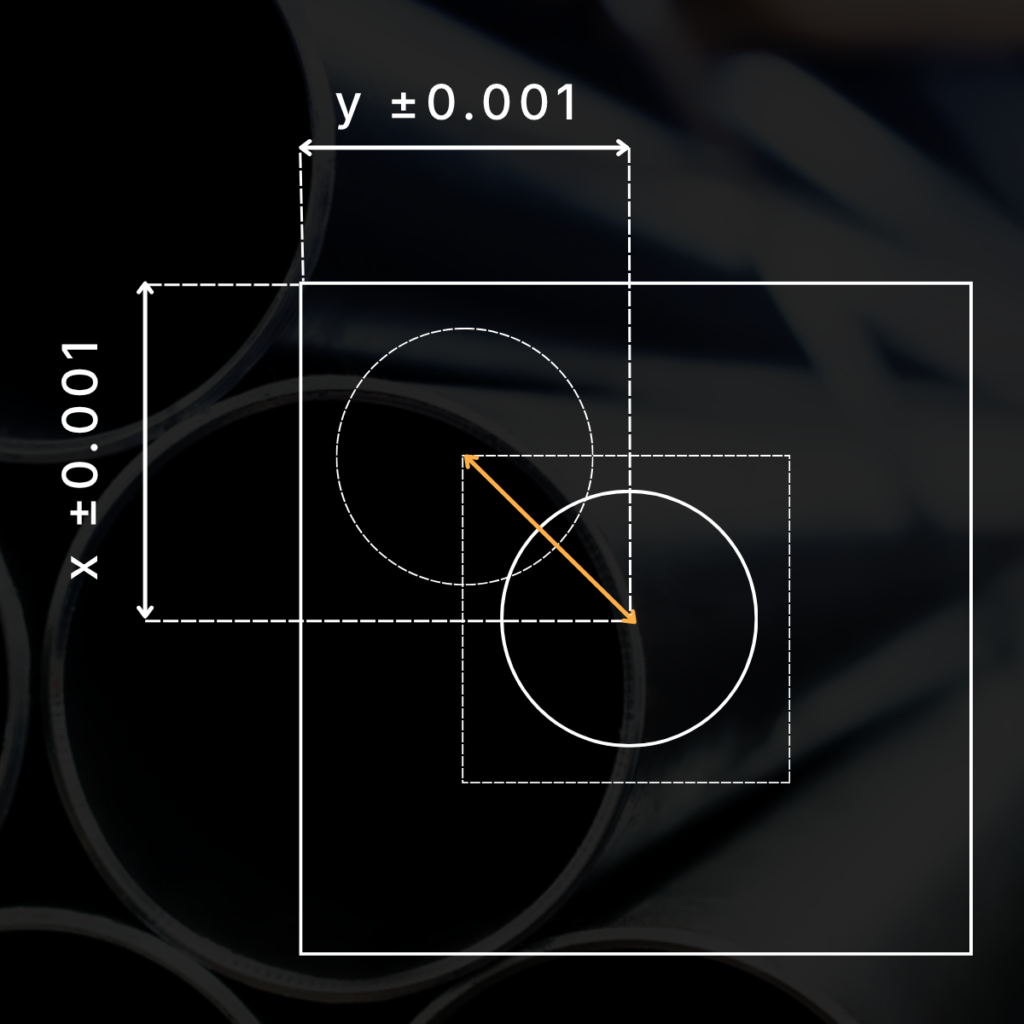
So instead of describing the tolerance as a square, we can define it as a circle with a radius of 0.0014 m. When we do that, the allowable area becomes π*r2 ≈ π*(0.0014)2 ≈ 6.16*10-6 m2.
Compared to the original square area of 4*10-6 m2, this circular tolerance zone is about 57 % larger.
In practice, that means by switching to GD&T and True Position, you allow the same maximum deviation in every direction, avoid rejecting perfectly functional parts, and significantly reduce manufacturing waste, all without affecting fit or performance.
Stop putting round holes in square boxes!